Cannes and the Illusion of Arrival
This post was originally published on Substack: https://alexiamelocchi.substack.com/p/cannes-and-the-illusion-of-arrival
There was a time when the Cannes Film Festival felt untouchable.
It was by far not perfect, but felt exclusive.
The people who came there largely belonged there. Distributors. Financiers. Serious producers. International sales agents. Studio executives. Filmmakers with films actually screening. People who understood not only cinema, but also commerce.
Deals were signed long before anyone stepped on the Croisette.
Back then, the glamour had weight to it.
Mario Kassar hosting the Gipsy Kings at the Hotel Du Cap. Dino De Laurentis bringing Madonna into the orbit of cinema royalty. Lavish dinners where billion-dollar conversations unfolded between courses. Producers who could greenlight films over espresso. Investors arriving on yachts not to “manifest” a movie career, but to finance one.
The parties were extravagant enough to demonstrate an extension of power.
Cannes was never simply about fame.
It was about a business model that worked.
Companies would spend $15,000 or more for an office or booth space at the market and often walk away with millions in sales.
The economics made sense.
Today, Cannes feels like two completely different worlds awkwardly forced into the same zip code.
On one side, the real industry still exists quietly. The serious players gather in private suites at the Carlton, the Martinez, and the Majestic. They host intimate dinners. Attend private screenings. Conduct business on yachts far from the chaos of the Croisette. Meetings are strategic, selective, and often arranged weeks or even months in advance.
Because, contrary to the fantasy, major deals are rarely born spontaneously at Cannes. Most of them are already in motion before the first flashbulb goes off.
Then there is the other Cannes.
The crowded, chaotic, hyper-accessible version fueled more by aspiration than infrastructure.
Thousands of hopeful filmmakers, creators, influencers, actors, and entrepreneurs descend upon the city carrying projects that have never been properly vetted, financed, packaged, or market-tested. Many arrive with no scheduled meetings. No sales understanding or a realistic path to execution.
Hope is a beautiful thing.
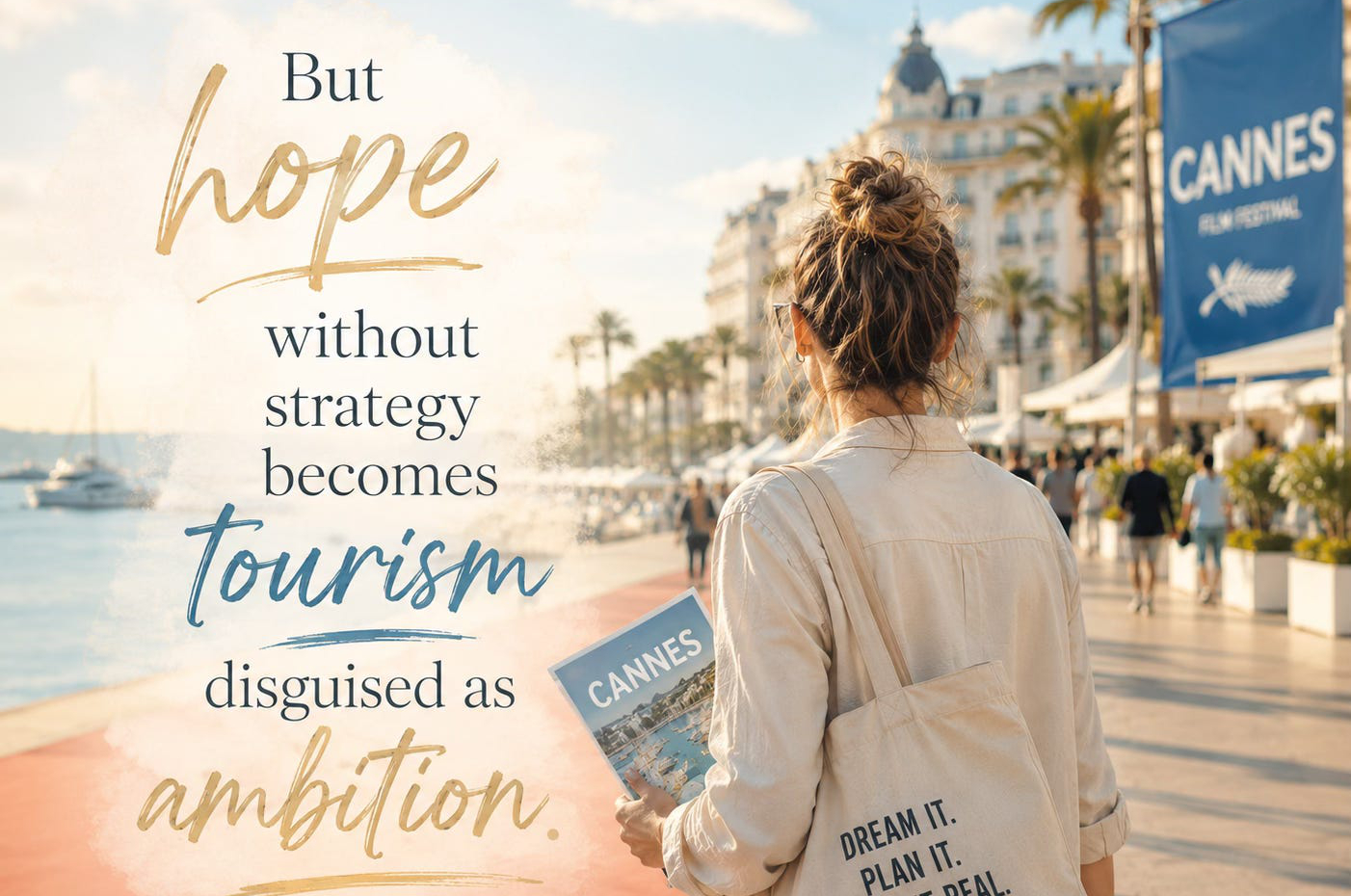
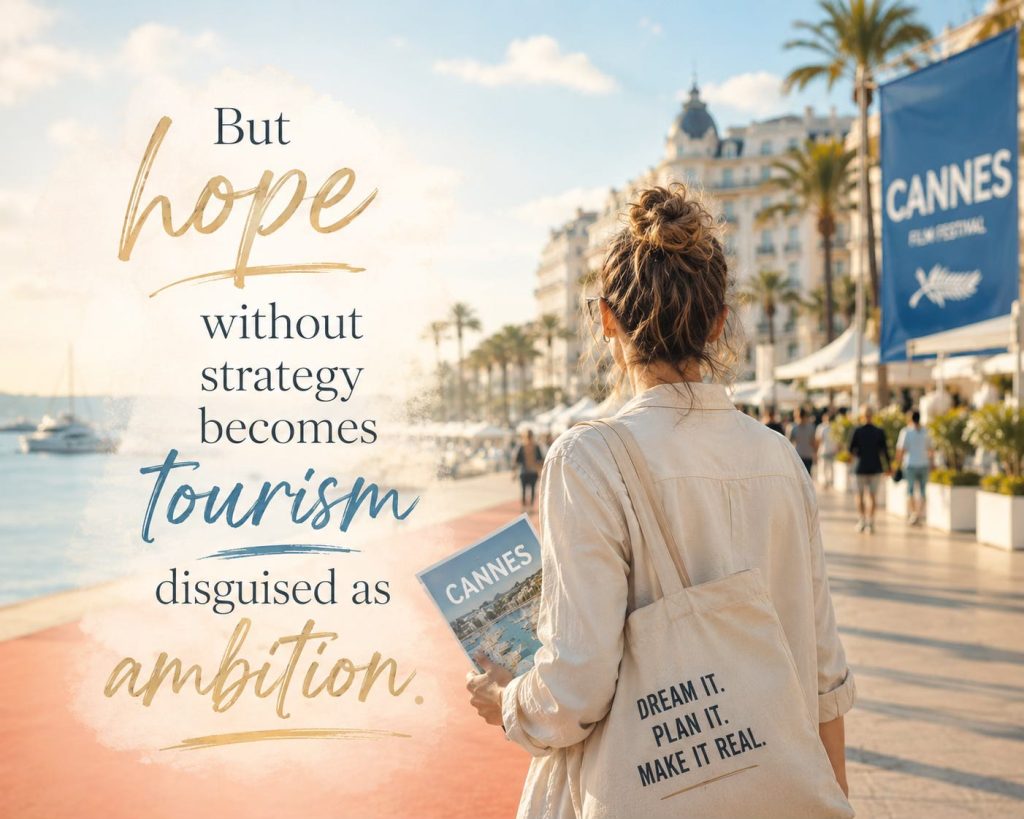
But hope without strategy becomes tourism disguised as ambition.
You see them in giant group chats asking where the next party is that they can crash. They sprint between panels and beach events, believing proximity equals progress. They pitch each other endlessly over cheap rosé and pub food, unaware that most people they meet will barely remember their name a week later.
Many arrive by train or bus. Sleep on couches. Share overcrowded apartments with strangers. Stretch one coffee for hours at hotel lobbies, they technically do not belong there.
And somehow, this strange ecosystem keeps feeding the illusion that attendance itself is achievement.
It isn’t.
Then come the influencers.
The red carpet that once symbolized cinematic prestige increasingly resembles a luxury-brand activation campaign. Influencers now often command more attention than filmmakers. Brands pay extraordinary sums for visibility while actual cinema fights for oxygen underneath the spectacle.
The festival once rivaled the Oscars in mystique. Now parts of it feel closer to the Met Gala with subtitles.
And yet…
I still love Cannes.
I love the electricity of possibility.
The conversations at midnight.
The smell of the sea mixed with espresso and exhaustion.
The collision of cultures.
The film commissions proudly presenting their countries with warmth and optimism.
Those pavilions are filled with kind, intelligent people genuinely trying to help productions happen. Yet, tax credits or rebates are not instant financing. And many filmmakers pursuing international co-productions do not yet understand the infrastructure required to access those opportunities, such as legal counsel, cash-flow structures, and distribution pathways.
These are not glamorous words.
But they are the real language of filmmaking.
There is another side to this conversation that rarely gets discussed.
I genuinely feel for the exhibitors, sales agents, distributors, and buyers trying to keep this business alive in a collapsing marketplace.
Today, many are spending enormous amounts simply to maintain visibility and relationships in an ecosystem where fewer films are being bought, and fewer independent films are truly breaking through.
Many buyers look exhausted.
Many exhibitors are overwhelmed.
You can almost feel the fatigue of people trying to conduct serious business while constantly being interrupted by endless pitches for future projects that have no financing, no attachments, and often no realistic execution plan.
And yet, I understand both sides.
Because every established producer or filmmaker was once an outsider, too.
Perhaps the future of Cannes is not about excluding newcomers, but about creating clearer ecosystems where aspiration and professionalism can coexist without cannibalizing each other.
A space where emerging creators can truly learn the business instead of simply orbiting its image.
Because beyond the yachts, champagne, parties, and five-minute meetings, this industry still runs on one thing:
Real relationships built over time, trust, discernment, and actual execution.
I, the eternal optimist, still hope Cannes finds its balance again someday.
Not less ambitious, international, or exciting.
Just more elevated.
More exclusive in the right ways.
Sadly, when everyone is trying to get in, very few stop to ask whether they are truly ready once the door opens.
And Cannes, perhaps more than anywhere else in the world, has a brutal way of exposing that difference.
Perhaps the real question isn’t who gets into Cannes anymore… but what we are all hoping to find once we arrive
You can also follow my Substack newsletter here: https://alexiamelocchi.substack.com/
Leave a Reply
You must be logged in to post a comment.